
- Trainer/in: Christian Lange
- Trainer/in: Bernhard Leeb
- Trainer/in: Ralf Gerkmann
- Trainer/in: Julius Hallmann
Schedule:
Lectures: Tue 10.00-12.00, Thu 10.00-12.00 B 005
Exercise Sessions:
Tue 12.00-14.00 B 132 (Thilo Nolden)
Tue 14.00-16.00 B 045 (Vasily Rogov)
Wed 10.00-12.00 B 134 (Vasily Rogov)
Wed 16.00 - 18.00 B 005 (Sarah Haselbeck)
//////
Recommended literature:
1) L. Conlon, Differentiable Manifolds — A First Course, Birkhauser Verlag 1993.
2) S. Morita, Geometry of Differential Forms, Amer. Math. Soc. 2001.
3) 3. F. W. Warner, Foundations of Differentiable Manifolds and Lie Groups, Springer Verlag 1983.
- Trainer/in: Sarah Haselbeck
- Trainer/in: Dieter Kotschick
- Trainer/in: Thilo Nolden
- Trainer/in: Vasilii Rogov
Enrolment key: mlinfinmath
- Trainer/in: Zhipeng Huang
Einschreibekennwort: Analysis_3
- Trainer/in: Holger Rauhut
- Trainer/in: Ulrich Terstiege
- Trainer/in: Tizian Wenzel
Enrolment key: computationalstudents27
- Trainer/in: Christian Fries
- Trainer/in: Zhipeng Huang
- Trainer/in: Denys Klypkin
- Trainer/in: Cristina Caraci
- Trainer/in: Yaojun Wang
Einschreibeschlüssel: WS26VM3
- Trainer/in: Dirk Deckert
Einschreibeschlüssel: WS26SM3
- Trainer/in: Dirk Deckert
Einschreibeschlüssel: WS26M3
- Trainer/in: Sonali Das
- Trainer/in: Dirk Deckert
- Trainer/in: Leonard Petters
- Trainer/in: Junwoo Shin
- Trainer/in: Jago Silberbauer
- Trainer/in: Luca Franciosi
- Trainer/in: Leonhard Pfaller
- Trainer/in: Alessandro Sgarabottolo
- Trainer/in: Thành Nam Phan
- Trainer/in: Sebastian Hensel
- Trainer/in: Thomas Vogel
- Trainer/in: Panagiotis Papadopoulos
- Trainer/in: Thomas Vogel
Enrolment key: cs2027
- Trainer/in: Leonardo Galli
- Trainer/in: Tizian Wenzel
enrollment key: RAODL2027
- Trainer/in: Leonardo Galli
Course Description
A modern mathematician needs solid programming and data analysis skills to solve real-world problems in finance, medicine, technology, and science. Working with data, solving mathematical problems computationally, and visualizing results are essential skills that complement mathematical knowledge.
Therefore, the aim of this course is to bridge the gap between mathematics and computer science for mathematics students. We will provide an introduction to the Python programming language and its applications in mathematics and data analysis. Specifically, we will focus on packages for scientific computing and linear algebra (NumPy, SciPy), data handling (Pandas), visualization (Matplotlib), and symbolic computation (SymPy). Finally, we will discuss the opportunities and challenges arising from the use of large language models (LLMs) and coding agents.
Enrollment Key CM2627
- Trainer/in: Jonas Bresch
- Trainer/in: Pascal Esser
Einschreibeschlüssel: Ana2627
- Trainer/in: Margherita Ferrero
- Trainer/in: Tamas Makai
- Trainer/in: Peter Müller
Enrolment key: FA2WS2627
- Trainer/in: Rupert Frank
- Trainer/in: Riccardo Panza
For more information, please see here.
- Trainer/in: Adalbert Fono
- Trainer/in: Miriam Kranzlmüller
- Trainer/in: Gitta Kutyniok
- Trainer/in: Jonas Beyrer
- Trainer/in: Sebastian Hensel
- Trainer/in: Sebastian Hensel
- Trainer/in: Thomas Vogel
Montag 12-14 Uhr in C123 und Donnerstag 10-12 Uhr im Großen Physikhörsaal N120, Zentralübung: Montag 16-18 Uhr in B138
Beginn: 12.10.2026
Die Vorlesung ist die erste eines dreisemestrigen Kurses in Mathematik für das Physikstudium.
Stichpunkte zum Inhalt:
- Mengen und Abbildungen
- Vollständige Induktion
- Gruppen, Körper und Vektorräume
- reelle und komplexe Zahlen
- lineare Abbildungen, lineare Gleichungssyteme und Matrizen
- Determinanten, Eigenwerte und Eigenvektoren
- Normalformen von Matrizen, selbstadjungierte, orthogonale und unitäre Matrizen
Einschreibung mit Kennwort m1p
- Trainer/in: Julian Becker
- Trainer/in: Alois Wohlschlager
- Trainer/in: Heribert Zenk
Dienstag 10-12 Uhr in B138 und Freitag 10-12 Uhr in B138, Zentralübung Freitag 8.30-10 Uhr in B138
Beginn: Dienstag 13.10.2026
Die Vorlesung ist die dritte eines dreisemestrigen Kurses in Mathematik für das Lehramt an Gymnasien nach der neuen Prüfungsordnung. Stichpunkte zum Inhalt:
- Funktionen einer Variablen: Ableitung und höhere Ableitungen
- Maß und Integration
- Funktionen mehrerer Variabler: Ableitung und höhere Ableitungen
- Differential- und Integralrechnung
Einschreibung mit Kennwort mehranalysis
- Trainer/in: Philipp Patzelt
- Trainer/in: Hanna Schmidt
- Trainer/in: Leonard Von Der Haar
- Trainer/in: Heribert Zenk
Montag 10-12 Uhr in B251, Dienstag 12-14 Uhr in B251 und Übung Dienstag 8.30-10 Uhr in B251
Beginn am 12. Oktober 2026.
Diese Veranstaltung zählt für WP25 "Fortgeschrittene Themen aus der Analysis und der Mathematischen Physik" im Masterstudiengang Mathematik (PO 2021)
Einschreibung mit Kennwort: stoerung
- Trainer/in: Heribert Zenk
Wir werden typische Aufgabenstellungen beim Staatsexamen in Analysis behandeln, Lösungsmethoden besprechen und evtl. noch etwas zugrunde liegende Theorie wiederholen. Wir beginnen mit dem Themenbereich Gewöhnliche Differentialgleichungen und arbeiten uns dann zur Funktionentheorie durch.
Beginn: Donnerstag 15.10.26 um 8.30 Uhr
Einschreibung mit Kennwort analysisexamen
- Trainer/in: Heribert Zenk
Einschreibeschlüssel: Querschnitt26W
- Trainer/in: Adalbert Fono
- Trainer/in: Erwin Schörner
Einschreibeschlüssel: Grundlagen1W26
- Trainer/in: Oliver Hendrichs
- Trainer/in: Daniel Rost
- Trainer/in: Erwin Schörner
Einschreibeschlüssel: ExamUF26W
- Trainer/in: Daniel Rost
- Trainer/in: Erwin Schörner
Einschreibeschlüssel: Reku2627
Dieser Kurs richtet sich an angehende Studierende der Mathematik/Wirtschaftsmathematik sowohl im Bachelor als auch für das Lehramt Gymnasium. Ziel ist es, mathematische Grundfertigkeiten zu vermitteln und einzuüben, die für das Studium wichtig sind.
- Trainer/in: Dmytro Bondarenko
- Trainer/in: Ulrich Terstiege
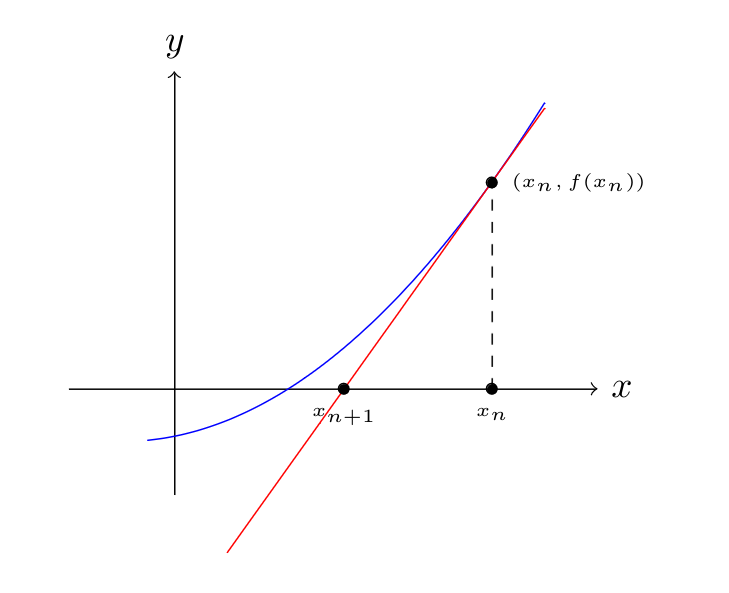
Inhalt der Vorlesung ist eine Einführung in die Optimierung in - vornehmlich - endlicher Dimension. Wichtige Themen und Inhalte sind unter anderem:
Konvexität, Lineare Programme und ihre Standardformen, Existenz von Lösungen für lineare Programme, Dualitätstheorie für lineare Programme, das Simplexverfahren, Formulierung und Existenz von Lösungen konvexer Optimierungsprobleme, duale Darstellung konvexer Funktionen und die Kuhn-Tucker-Theorie.
Einschreibeschlüssel: Opt26/27
- Trainer/in: Julian Becker
- Trainer/in: Konstantinos Panagiotou
Die Vorlesung gibt eine Einführung in die Theorie fundamentaler algebraischer Strukturen. Unter anderem behandeln wir elementare Gruppentheorie, Gruppenoperationen, die Sylow-Sätze, Ringtheorie, insbesondere Teilbarkeit, Ideale und Polynomringe, sowie Körpererweiterungen und Galoistheorie. Als Anwendung beweisen wir, dass für Polynome vom Grad >= 5 keine allgemeine Lösungsformel existiert.
- Trainer/in: Andreas Rosenschon
- Trainer/in: Lukas Müller
- Trainer/in: Arnaud Triay-Alcouffe
Description
In the seminar, we will discuss real and complex analysis as well as measure and integration theory on a constructive basis (TCF).
We will further formalize the proofs using the proof assistant Minlog.
The seminar targets bachelor as well as master students with an interest in mathematical logic and constructive mathematics.
Prerequisites:
- basic knowledge of mathematical logic is required
- participants are expected to have completed the Minlog tutorial
Upon successful completion of the seminar, students will have the opportunity to write a Bachelor’s or Master’s thesis on a topic related to the subject area covered in the seminar.
Enrollment Key: Konstruktive_Analysis
- Trainer/in: Helmut Schwichtenberg
- Trainer/in: Noah Wedlich
- Trainer/in: Katharina Wendler
Course Description
This seminar analyses one-dimensional stochastic differential equations (SDEs) driven by a Brownian motion. Built upon a concise review of semimartingale theory, stochastic integration and Itô's formula, the course establishes the existence and uniqueness of strong solutions under Lipschitz conditions on the drift and diffusion coefficients of the SDE. A special emphasis is placed on affine SDEs, recovering the Brownian bridge, geometric Brownian motion and Ornstein-Uhlenbeck process as explicit solutions.
Target Participants
- Master students of Mathematics and Financial and Insurance Mathematics
Pre-requisites
- Probability theory and measure and integration theory
Registration key
- SDEs
- Trainer/in: Alexander Kalinin
Course Description
This course provides a rigorous foundation in the advanced theory of stochastic processes featuring Polish state spaces and arbitrary parameter sets. The lectures are devoted to the general construction of stochastic processes, encompassing a systematic analysis of their sample path regularity and distributional properties. In particular, we will focus on Gaussian fields and Lévy processes and derive efficient simulation schemes employing generative artificial intelligence.
Target Participants
- Master students of Mathematics and Financial and Insurance Mathematics
Pre-requisites
- Probability theory and measure and integration theory
Registration key
- Processes
- Trainer/in: Alexander Kalinin
The lecture provides an introduction to stochastic calculus with an emphasis on the mathematical concepts that are later used in the mathematical modeling of financial markets.
In the first part of the lecture course the theory of stochastic integration with respect to Brownian motion and Itô processes is developed. Important results such as Girsanov's theorem and the martingale representation theorem are also covered. The first part concludes with a chapter on the existence and uniqueness of strong and weak solutions of stochastic differential equations.
The second part of the lecture course gives an introduction to the arbitrage theory of financial markets in continuous time driven by Brownian motion. Key concepts are the absence of arbitrage, market completeness, and the risk neutral pricing and hedging of contingent claims. Particular attention will be given to the the Black-Scholes model and the famous Black-Scholes formula for pricing call and put options.
If you wish to participate in the course, please send an email from your LMU email address to Miguel Armayor Martínez with the subject "Registration Fima II WiSe 2026/27".
- Trainer/in: Miguel Armayor Martínez
- Trainer/in: Zhipeng Huang
- Trainer/in: Thilo Meyer-Brandis

Die Problemlabs bieten einen betreuten Lern und Arbeitsraum in dem ihr Übungsaufgaben bearbeiten könnt. Dabei werdet ihr von ehrenamtlichen Studierenden unterstützt, die eure Fragen beantworten.
Die Problemlabs richten sich vor allem an Studierende im ersten Semester.
🔑 Selbsteinschreibung
Einschreibeschlüssel: NoProblem
- Trainer/in: Kajetan Söhnen
Weitere Informationen finden Sie hier.
- Trainer/in: Miriam Kranzlmüller
- Trainer/in: Johannes Maly
In dieser Vorlesung behandeln wir gemeinsam die Grundlagen der (Hochschul-)Mathematik.
Thematisch
beginnen wir bei fundamentalen Begriffen wie Mengen und Abbildungen,
sprechen dann über zentrale Begriffe der Analysis wie Folgen und
Stetigkeit und widmen uns am Ende Ableitungen und Integrale.
Die
Veranstaltung richtet sich an Studierende verschiedener
Bachelorstudiengänge, wie z.B. Geowissenschaften und Informatik mit
großem Nebenfach.
Anmeldeschlüssel: MfNW
- Trainer/in: Julia Philipp
- Trainer/in: Kajetan Söhnen
- Trainer/in: Marie-Luise Thös
- Trainer/in: Alessandro Sgarabottolo
Einschreibeschlüssel: AnIS2627
- Trainer/in: Jan Philipp Neumann
- Trainer/in: Peter Philip
Einschreibeschlüssel: Num2627
- Trainer/in: Paul Pfeiffer
- Trainer/in: Peter Philip
pwd: lieshout
- Trainer/in: Sabine Jansen
Einschreibeschlüssel: ewens
- Trainer/in: Sabine Jansen
- Trainer/in: Sabine Jansen
Blockkurs in der vorlesungsfreien
Zeit, in dem die Grundlagen des Textsatzsystems LaTeX und speziell die
Erstellung mathematischer Texte behandelt werden. Nähere Informationen
zum Ablauf finden Sie auf der Webseite des Kurses.
Einschreibeschlüssel: LaTeX26
- Trainer/in: Mechtild Callies
Eine Reihe von Workshops für angehende Hilfskräfte des mathematischen Instituts.
- Trainer/in: Sebastian Hensel
- Trainer/in: Alexander Rachel
- Trainer/in: Kajetan Söhnen
- Trainer/in: Christian Lange
- Trainer/in: Bernhard Leeb
Einschreibeschlüssel: MathStat26/27
- Trainer/in: Paula Reichert-Schürmer
Einschreibeschlüssel: LinAlg26/27
- Trainer/in: Wiebke Bartolomaeus
- Trainer/in: Adalbert Fono
- Trainer/in: Paula Reichert-Schürmer
Einschreibeschlüssel: DiffInt26/27
- Trainer/in: Wiebke Bartolomaeus
- Trainer/in: Adalbert Fono
- Trainer/in: Paula Reichert-Schürmer
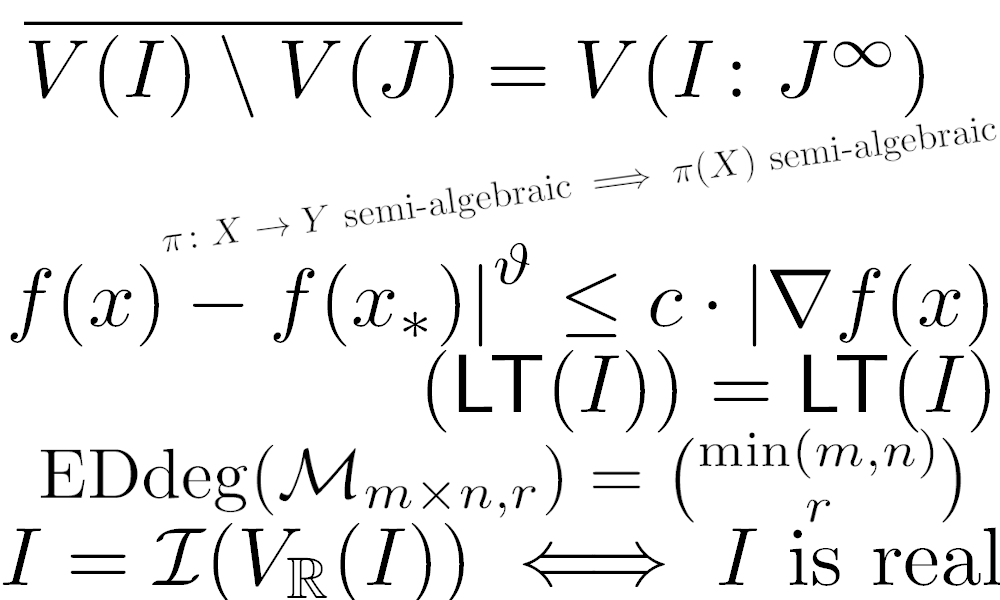
In this course, we explore connections between machine learning, algebraic geometry and real algebraic geometry.
We will introduce the Euclidean Distance Degree and analyze determinantal varieties arising in machine learning. In the second part of the course, we cover the Tarski--Seidenberg principle, a theorem of Positivstellensatz type, and Łojasiewicz' inequality, while on the application side turning more towards training dynamics.
Enrollment key: Hilbert17
- Trainer/in: Ulrich Terstiege
- Trainer/in: Simon Weinzierl

Analysis und Lineare Algebra I (Lehramt Gymnasium)
📚 Analysis und Lineare Algebra I ist die Mathematikvorlesung für das erste Semester im Lehramtsstudium Gymnasium mit Fach Mathematik (Prüfungsordnung 2022).
Auch WiPäd-Studierende mit Wahlfach Mathematik sind hier richtig, wenn sie die Module Lineare Algebra I für Studierende der Wirtschaftspädagogik bzw. Analysis I für Studierende der Wirtschaftspädagogik belegen möchten.
🗓️ Veranstaltungen:Dienstag 12–14 Uhr · Mittwoch 14–16 Uhr · Donnerstag 10–12 Uhr · Freitag 12–14 Uhr ·📍 jeweils in Raum B138
🚀 Erste Veranstaltung:
Dienstag, 13.10.2026, 12–14 Uhr in Raum B138
Einschreibeschlüssel:
ala1
- Trainer/in: Christopher Abel
- Trainer/in: Fabian Darabi Far
- Trainer/in: Carolina Fäustlin
- Trainer/in: Sarah Haselbeck
- Trainer/in: Jakob Nothelfer
- Trainer/in: Julia Philipp
- Trainer/in: Anna Ribelles Perez
- Trainer/in: Kajetan Söhnen
- Trainer/in: Marie-Luise Thös
- Trainer/in: Katharina Wendler
- Trainer/in: Laurin Wolf
Signing up opens 05. October 2026.
- Trainer/in: Thomas Sørensen
Signing up opens 05. October 2026.
- Trainer/in: Lukas Junge
- Trainer/in: Thomas Sørensen