
- المعلم: Annabelle Bohrdt
- المعلم: Giorgia Busin
- المعلم: Quinten Akkerman
- المعلم: Erkan Aydin
- المعلم: Emiliano Cortés
- المعلم: Alena Khmelinskaia
- المعلم: Edoardo Mariani
Thursday, 2pm to 4 pm, seminar room N110. This is a 3 SWS (2h) lecture.
Course Scope: This lecture provides a comprehensive introduction to X-ray physics, covering the fundamental principles, experimental techniques, and applications used to determine the structure of matter.
Practical Relevance: Applications span nanoparticle synthesis, lipid membranes, semiconductor oxides, catalysis, and the search for life's origins in mineral pores.
Learning Objectives: Students should gain a working understanding of X-ray scattering theory, experimental design, data analysis, and the breadth of scientific questions addressable by X-ray methods.
1. Historical Foundations: We begin with Röntgen's discovery of X-rays in 1895 and trace the pivotal experiments by von Laue, Friedrich, Knipping, and the Braggs that established X-ray diffraction as a structural tool.
2. Core Physics: The lecture establishes the theoretical basis, including Thomson scattering, the scattering vector Q, atomic form factors, and the distinction between coherent and incoherent scattering processes.
3. Absorption and Contrast: We examine photoabsorption cross sections, absorption lengths, and how these properties enable techniques such as medical CT imaging and material-specific contrast.
4. Kinematical Scattering: The Debye formula is developed to describe scattering from atomic pairs and assemblies, forming the foundation for pair distribution function (PDF) analysis.
5. PDF Analysis: We discuss how time-resolved PDF studies reveal nucleation pathways in nanoparticle synthesis and how data treatment via Fourier transform yields atomic pair correlations.
6. Compton Scattering: The inelastic Compton effect is treated as a background contribution that must be understood and subtracted, particularly for high-Q experiments.
7. Liquids and Disorder: The radial distribution function and liquid structure factor are derived, connecting measured scattering intensities to atomic-scale ordering in disordered systems.
8. X-Ray Optics: We cover the refractive index for X-rays, Snell's law, critical angle, evanescent waves, and the principles behind X-ray lenses, mirrors, and compound refractive optics.
9. Surface Sensitivity: Grazing incidence techniques and the distorted wave Born approximation are introduced for studying surfaces, interfaces, and thin films with depth resolution.
10. X-Ray Reflectometry: The Fresnel formalism, Kiessig fringes, and Parratt's recursive method are presented for analyzing layered structures and obtaining depth profiles.
11. Small-Angle X-Ray Scattering (SAXS): We derive form factors for spheres, hollow spheres, and other shapes, and discuss instrumentation, background reduction, and data interpretation.
12. Structure Factors in SAXS: The hard-sphere model and Percus-Yevick structure factor are introduced to describe particle correlations in concentrated systems.
13. Fractal and Hierarchical Materials: Power-law scattering from mass and surface fractals is explained, with applications to porous rocks and hierarchical biological materials.
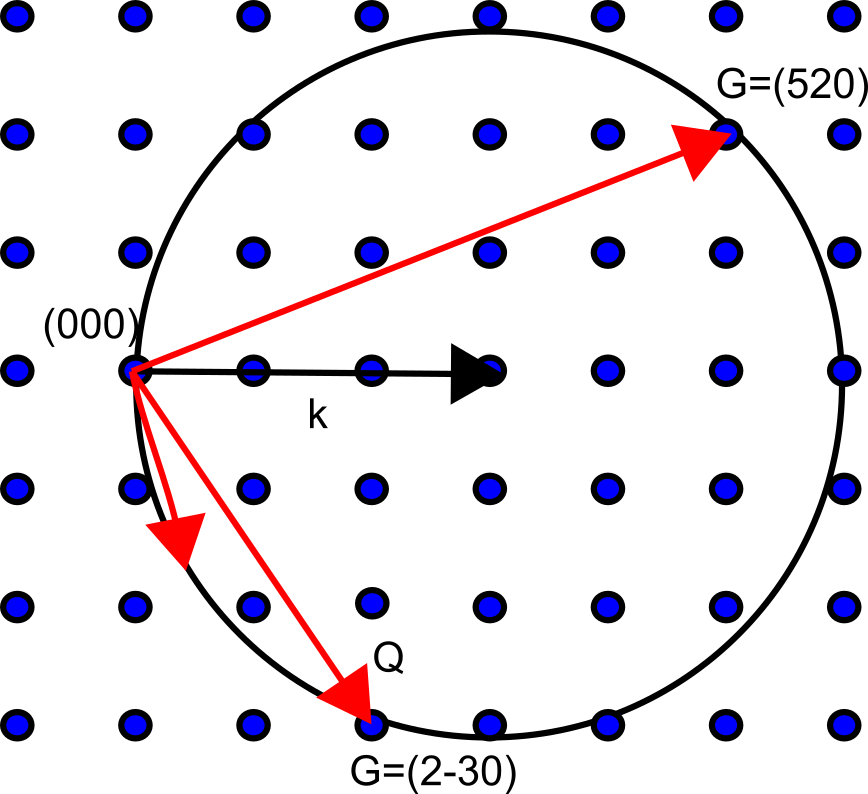
14. Bragg Diffraction: The reciprocal lattice, Laue conditions, Ewald sphere construction, and the lattice sum are developed as the framework for understanding crystalline diffraction.
15. Experimental Methods: Laue diffraction, rotating crystal method, area detectors, and high-energy diffraction are compared in terms of their capabilities and limitations.
16. Protein Crystallography: We review the impact of X-ray crystallography on structural biology, including the Protein Data Bank and the emerging role of AI-based structure prediction.
17. Thermal Effects: The Debye-Waller factor and diffuse scattering are discussed as means to study atomic vibrations, phonons, and phase transitions
- المعلم: Bert Nickel