
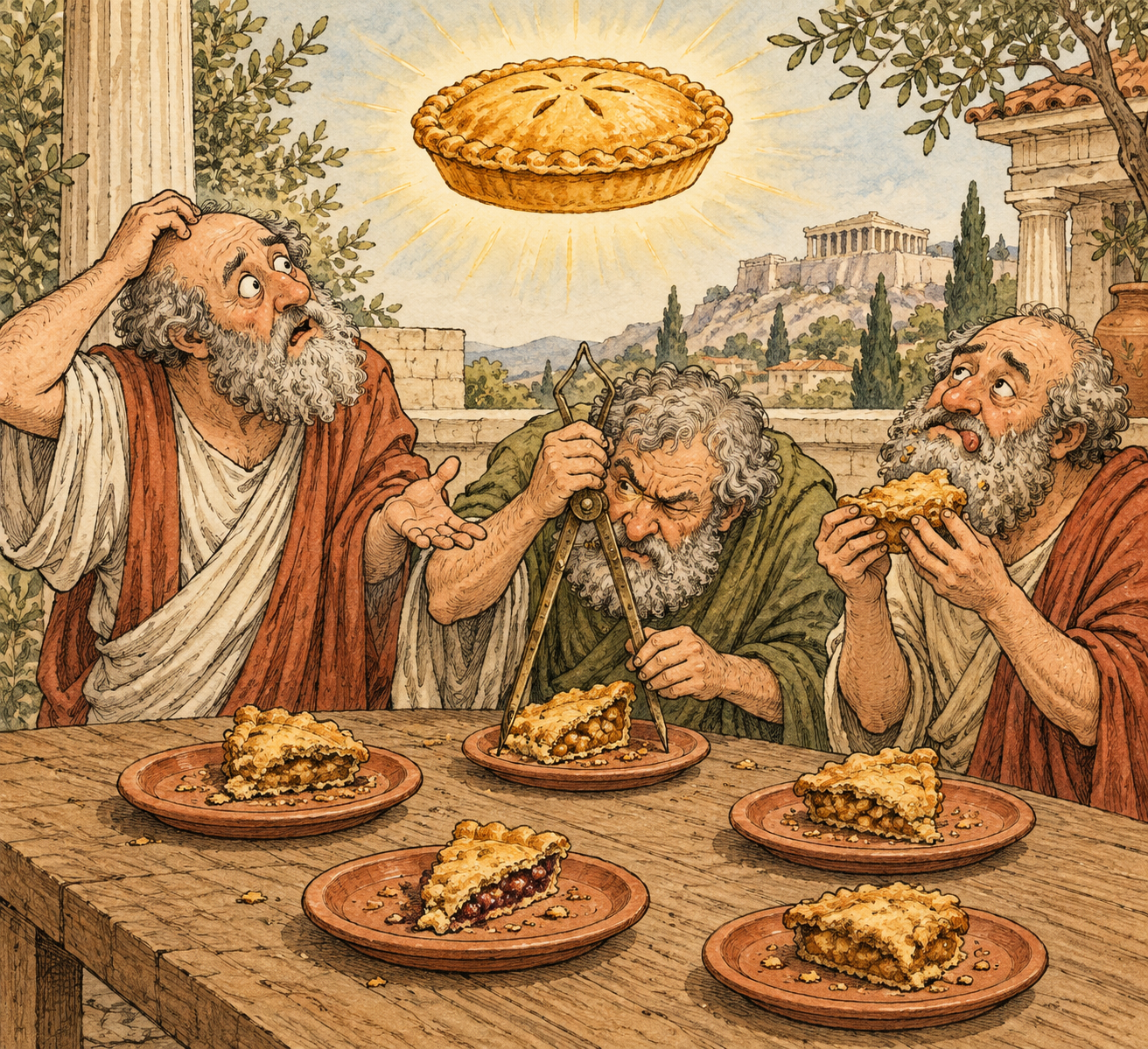
What is it that Leo Messi and Socrates share when both are called “man”? At the beginning of the Isagoge, Porphyry lists three questions he will not answer: whether genera and species subsist or reside in thoughts alone; whether, if they subsist, they are corporeal or incorporeal; and whether they exist apart from sensible things or in them. Transmitted to the Latin West through Boethius, these questions became the starting point for the medieval debate over universals. We will use them to recover the ancient controversy behind that debate, from its Platonic beginnings to its late antique reformulation.
We begin with the Isagoge and Boethius’ commentary, then turn to the sources of the problem: the opening arguments of Plato’s Parmenides; Aristotle’s De Ideis and his account of universals in the Organon, along with the problems posed in Metaphysics B and Z 13. A fundamental issue lies at the center of the Aristotelian polemics: can what is common to many things itself be a substance, i.e. a fundamental item in reality?
The second half of the seminar considers how later ancient philosophers answered that question. Topics include Alexander of Aphrodisias’ distinction between form and universal; the Stoic treatment of universals as concepts and the “not-someone” argument; the Epicurean theory of preconception and Philodemus’ account of inference from similarity; Sextus Empiricus’ skeptical arguments against genera and species. Finally, we turn to the Neoplatonists: Proclus’ account of immanent and transcendent forms and his critique of abstraction, followed by Ammonius’ doctrine of the threefold universal.
All texts will be read in translation. Knowledge of ancient Greek is recommended but not required. Some familiarity with Plato and Aristotle will be helpful
- Enseignant: Leonardo Chiocchetti